Mind the Gap.
Signal Classification
Permanent catalog artifact. Always available. No scarcity guarantee, series coin, reactive material, or system binding.
Lock Level
Level 3 (Interpretable) artifacts encode meaning across visual and structural layers. Full resolution requires decoding or contextual knowledge.
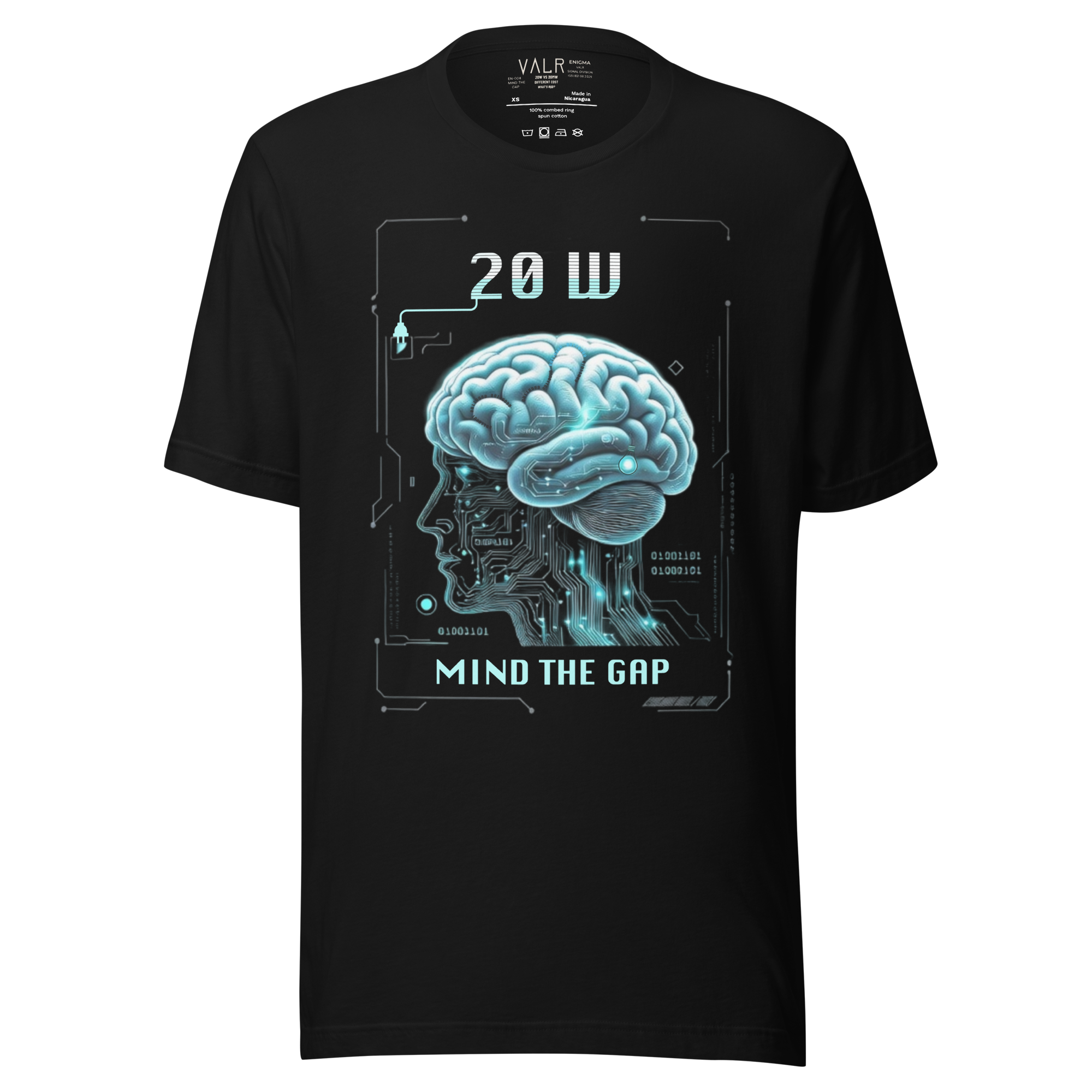
20W. 20MW.
A human brain runs on roughly 20 watts. An exascale-class AI supercomputer may demand tens of megawatts of facility power. Both can confront the same question — they do not arrive with the same requirements. MIND THE GAP turns that difference into a wearable prompt: before choosing the fastest, largest or most familiar tool, ask what the task actually requires.
SAME PROBLEM. DIFFERENT COST.
A Service-Disabled Veteran-Owned Small Business · Sharon, MA
Core Signal. No expiry. Full design record unlocks upon decode — or automatically after 12 months in the field.
This artifact is built around a discovery experience that unfolds over time. If you’d like a partial reading before you buy, you can request one below — it will not tell you everything.
MIND THE GAP is designed as both a reminder to consider the right / best tool for a job but also that the human brain is exceptionally efficient and capable of complex, challenging tasks and real imagination. AI can absolutely contribute to imagination. Humans can absolutely analyze datasets. What really matters is understanding the appropriateness, cost, and what gets sacrificed or gained by choosing a particular route. They do not arrive with the same requirements.
Front — a cyan brain glows against black or purple. The large 20W mark reminds us how little energy our brain requires to operate despite the immense, complex system it runs while multi-tasking to think, imagine and solve problems. The footer carries a warning: MIND THE GAP.
A call to action and reminder to choose the right tool for the job. However, nothing here is only what it looks like at first glance.
Back — human brain and AI supercomputer face the same problem from opposite sides of a field of energy and infrastructure. To achieve the same level of compute the energy cost is drastically different. The visible conclusion is direct: SAME PROBLEM. DIFFERENT COST.
The comparison is intentionally provocative, not absolute. The systems do different work in different ways. The point is to notice the gap before pretending the requirements are interchangeable. The fire does two things at once: it draws attention to the danger of that much power, and it points to the vast amount of water — fire’s classical opposite — needed to cool the equipment consuming it, in effect putting the fire back out. As a comparison, a 20–30 meter long wildfire gives off roughly the same heat energy as that level of AI compute.
MIND THE GAP. THEN ASK WHAT’S REQUIRED.
Minding the gap is not choosing the smaller number.
It is seeing the true requirement.